
There is no fixed timeline for rebuilding trust after infidelity in therapy, and attending sessions does not guarantee any specific outcome. Progress depends on whether the betrayal has stopped, whether both partners can participate safely, and whether accountability continues outside therapy. If you are starting therapy, ask for a plan based on your circumstances rather than a promised recovery date.
- Rebuild trust after infidelity therapy should focus on accountability and safety, not a promised completion date.
- PhIIRST offers individual, couples, and sex therapy in Philadelphia and Media, PA and virtually.
- Trust grows through consistent behavior; attendance alone does not establish repair.
- Reconciliation, forgiveness, and renewed sexual intimacy are separate decisions, not required treatment outcomes.
Why this matters
You might want a deadline because uncertainty is exhausting. The partner who experienced betrayal might need reassurance that distress will not define the relationship indefinitely; the partner who broke an agreement might want to know whether repair is possible. Neither need makes a calendar an adequate measure of trust.
Phiirst is best suited to people seeking individual, couples, or sex therapy in Philadelphia or Media, PA. You can explore Phiirst when considering local support. The more useful question is whether the care you seek addresses your relationship concerns while respecting your choices about staying together.
How long does it take to rebuild trust after infidelity in therapy?
Rebuilding trust after infidelity does not follow a universal treatment schedule. A therapist can help you identify priorities and review progress, but cannot determine when another person will feel safe or whether the relationship will continue.
Treat any 2026 recovery timetable as general information, not a prediction about your relationship. The following steps offer a way to organize the work without turning it into a deadline.
- Establish safety. Discuss whether both partners can speak freely and whether there is intimidation, coercion, or fear. A clinician should assess whether joint sessions are appropriate before treating the situation as a shared communication problem.
- Clarify agreements. Identify what agreement was broken, what remains uncertain, and what boundaries apply now. Repair requires clarity about the relationship you actually have, including consensually nonmonogamous relationships.
- Practice accountability. Look for honest answers, acknowledgment of harm, and follow-through on agreed actions. An apology matters, but repeated behavior gives you more information than a promise alone.
- Review progress. Discuss what is changing, what remains painful, and whether the therapy approach still fits. Reviewing progress is different from demanding that someone stop feeling hurt.
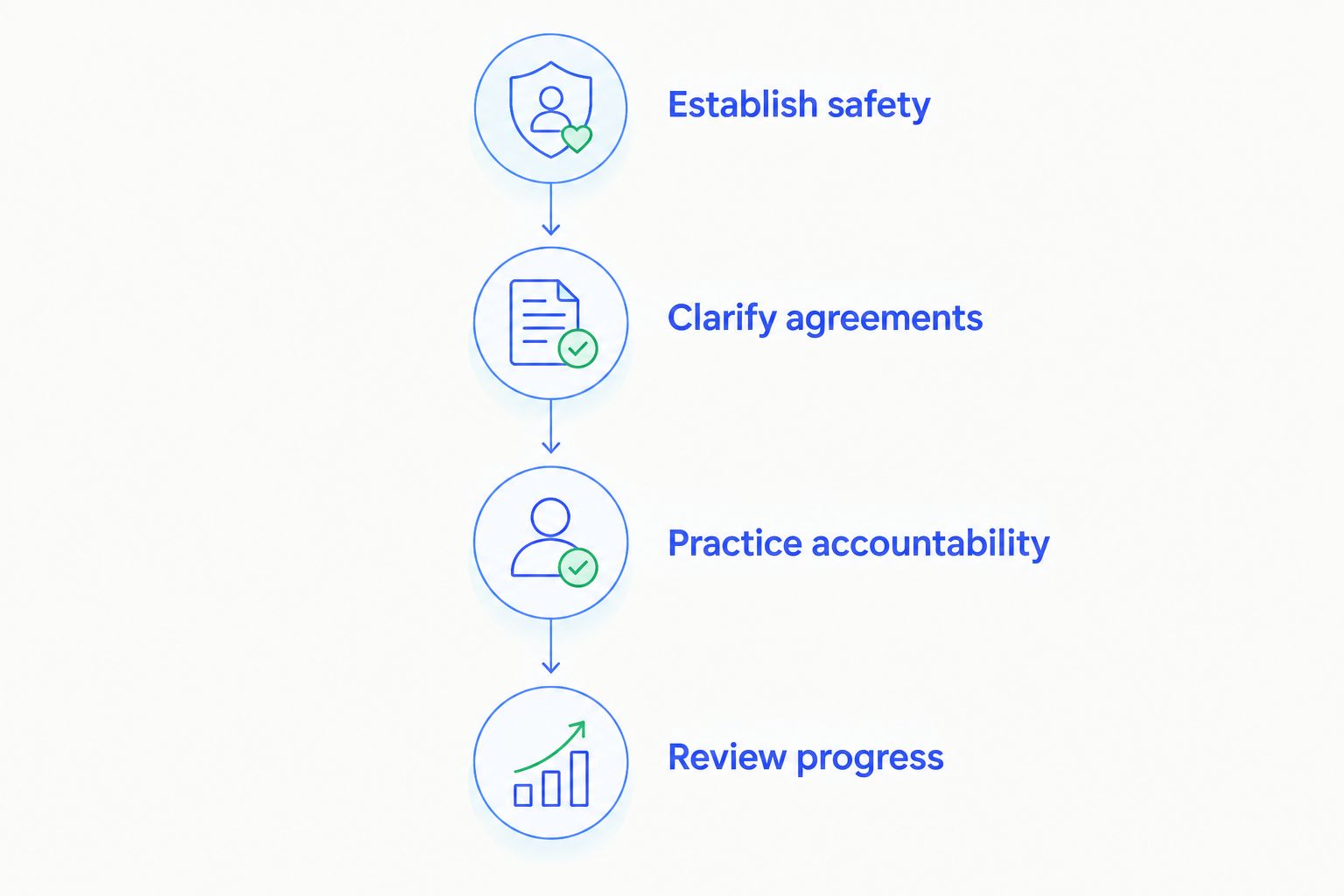
These priorities can overlap. You might revisit boundaries after a difficult conversation or reassess safety when new information emerges. Returning to a topic does not automatically mean therapy has failed; the important question is what the return reveals and whether anything changes afterward.
Early work: establish safety and clarity
The beginning of therapy does not have to include every detail of the betrayal. You can start by naming what brought you in, what feels hardest now, and what you need to understand before making decisions.
Ask how the therapist handles information shared separately from a partner, confidentiality, and discussions of infidelity. Do not assume every couples therapist follows the same policy. Understanding those boundaries helps you decide what to disclose and how to participate.
Safety takes priority over reconciliation. If you fear retaliation, punishment, or coercion, seek confidential individual support before arranging a joint conversation. A shared session is not automatically a safe setting simply because a professional is present.
Ongoing work: connect promises with behavior
Trust repair involves what happens between appointments. Examples to discuss include whether agreements are kept, whether difficult questions receive respectful answers, and whether responsibility is acknowledged without making the hurt partner manage the other person's guilt.
Accountability does not mean unlimited access to another person's devices or permanent surveillance. Discuss what information is relevant, what transparency would mean, and whether any proposed arrangement is freely agreed rather than imposed through threats.
Relationship difficulties can deserve attention without becoming an explanation that excuses betrayal. Both partners can examine communication or intimacy concerns, while responsibility for breaking an agreement remains with the person who broke it.
Later decisions: assess the relationship you want
Feeling less overwhelmed is not the same as deciding to stay. You might become clearer about your needs and still conclude that the relationship no longer fits them.
Likewise, choosing to continue does not mean that every concern has resolved. Discuss what a workable relationship would require now, including boundaries, emotional connection, sexual consent, and how future disagreements will be handled.
A useful review asks whether there is evidence for renewed trust, not whether enough time has passed to make distrust inconvenient. Your decision should reflect what is happening, rather than pressure to produce a successful ending.
Why the pace of trust repair varies
Several factors help explain why a single timeline is not useful:
- Continuing deception: Ongoing secrecy leaves the central trust problem unresolved. Distinguish discomfort with an honest answer from evidence that important information is still being withheld.
- Safety and freedom to disagree: Repair requires room to express concerns without intimidation. Fear changes what someone can safely say in joint therapy.
- Accountability outside sessions: Promises made during an appointment need to connect with behavior afterward. Discuss specific agreements instead of relying on general assurances.
- New information: Additional disclosures can change your understanding of what happened. Bring that change into therapy rather than insisting that earlier progress should erase its impact.
- Different relationship goals: One partner might seek reconciliation while another seeks clarity about leaving. Naming that difference helps establish an honest purpose for therapy.
- Emotional and sexual boundaries: Willingness to talk, readiness for touch, and interest in sex do not necessarily return together. Each requires separate attention and consent.
These factors are discussion points, not a scoring system. You do not need to prove that your distress is serious enough to deserve support.
Choosing therapy support in 2026
Individual therapy, couples therapy, and sex therapy address related but distinct concerns. None is a substitute for assessing safety or respecting a person's decision not to continue a relationship.
| Type of support | Best for | What it can address | Limitation to understand |
|---|---|---|---|
| Individual therapy | Understanding your own needs and choices | Personal distress, boundaries, and relationship decisions | It cannot establish a partner's accountability or determine their intentions. |
| Couples therapy | Discussing shared agreements and relationship patterns | Communication, the impact of betrayal, and decisions about repair | Joint sessions are not appropriate in every safety situation and do not guarantee reconciliation. |
| Sex therapy | Addressing sexual and intimacy concerns | Desire, sexual communication, consent, and the effects of betrayal on intimacy | It does not replace medical assessment or make sexual contact a requirement of recovery. |
Phiirst offers all of these service categories. When making an inquiry, describe whether your main concern is relationship repair, uncertainty about staying, sexual intimacy, or some combination. Ask how the clinician approaches those concerns rather than assuming a service label answers every question about fit.
You can also ask about experience supporting your relationship structure, identities, and circumstances. A respectful inquiry does not require you to share intimate details before you understand the clinician's approach and confidentiality policies.
How can you tell whether trust is actually improving?
Look for changes you can describe, not a deadline you can reach. Useful questions include whether agreements are becoming clearer, whether difficult conversations involve less blame, and whether actions consistently match what was agreed.
Notice your own experience too. Can you express uncertainty without being told that therapy means you should already be over it? Can your partner hear the impact of the betrayal without requiring immediate reassurance?
Write down the concern you want to review before your next appointment. A specific example gives the therapist something to work with; a broad verdict that everything is better or nothing is changing can hide important differences.
Does a setback mean therapy is not working?
A setback does not by itself show whether therapy is helping. Distinguish a painful reminder from a new breach of an agreement: both deserve attention, but they are not the same event.
A reminder might involve distress around a place, message, or anniversary associated with the betrayal. A new breach raises a different question about current behavior and whether the conditions for repair exist.
Bring the distinction into therapy. Ask what happened, what response followed, and whether the plan needs to change rather than treating every difficult day as either proof of failure or something to dismiss.
Do you have to forgive before trust can return?
Forgiveness is not a prerequisite for seeking therapy. You can work on understanding what happened, setting boundaries, and making decisions without agreeing to forgive or stay.
Trust, forgiveness, and reconciliation describe different choices. Feeling compassion does not obligate you to resume the relationship, and remaining together does not automatically mean trust has returned.
The same distinction applies to sex. Sexual contact is not evidence that a betrayal has been resolved. You can want closeness and still decline touch, or agree to touch without agreeing to intercourse or any other sexual activity.
Questions to bring to an initial appointment
You do not need a complete account ready before asking for help. A short explanation of your concerns can begin a discussion about fit and next steps.
Consider asking:
- How do you assess whether couples sessions are safe and appropriate?
- How do you handle information shared separately by partners?
- How would we identify goals if we disagree about staying together?
- How do you distinguish accountability from blame or surveillance?
- How do you address sexual concerns without pressuring either partner?
- How will we review whether therapy is meeting our needs?
If sexual-health concerns are part of the betrayal, ask a qualified medical professional about assessment and testing. Therapy can address the emotional and relational impact, but it does not replace medical care.
FAQ
How long does rebuilding trust after infidelity take in 2026?
In 2026, there is still no universal timeline for rebuilding trust after infidelity. Discuss safety, accountability, and observable changes with your therapist rather than treating a recovery date as a guarantee.
Can couples therapy guarantee that we will stay together?
Couples therapy cannot guarantee reconciliation. It can provide a setting to discuss the betrayal, examine agreements, and clarify whether continuing the relationship fits each person's needs.
Can I start therapy if my partner will not attend?
You can seek individual therapy even if your partner does not attend. Individual work can address your distress, boundaries, and decisions, but it cannot establish your partner's intentions or make them accountable.
Do I have to describe every sexual detail in therapy?
You do not have to begin therapy by describing every sexual detail. Discuss what information serves your goals, what feels distressing, and how the therapist handles disclosures and confidentiality.
Should we resume sex to help rebuild trust?
Resuming sex is not a requirement for rebuilding trust. Any sexual contact requires freely given consent, and intimacy concerns can be discussed without making sexual activity a treatment goal.
Is sex therapy the same as couples therapy after infidelity?
Sex therapy and couples therapy have overlapping but distinct focuses. Couples work can address relationship agreements and communication, while sex therapy can address sexual concerns, consent, desire, and intimacy.
Does Phiirst offer support in Philadelphia or Media, PA?
Phiirst offers individual, couples, and sex therapy in Philadelphia and Media, PA. You can ask about care for relationship and intimacy concerns when making an inquiry.
One last thing
Before your next conversation, separate what you need to know from what you need to decide. You might need clarity about an agreement today without being ready to decide whether to stay.
You can seek support before you know the outcome you want. Therapy does not require a promise to reconcile; it starts with room to understand your needs and consider your choices.